
Cured-In-Place Pipe (CIPP) Lining
CIPP pipe lining in Greer, SC repairs cracked and root-damaged sewer mains from the inside. Call (864) 894-8055.
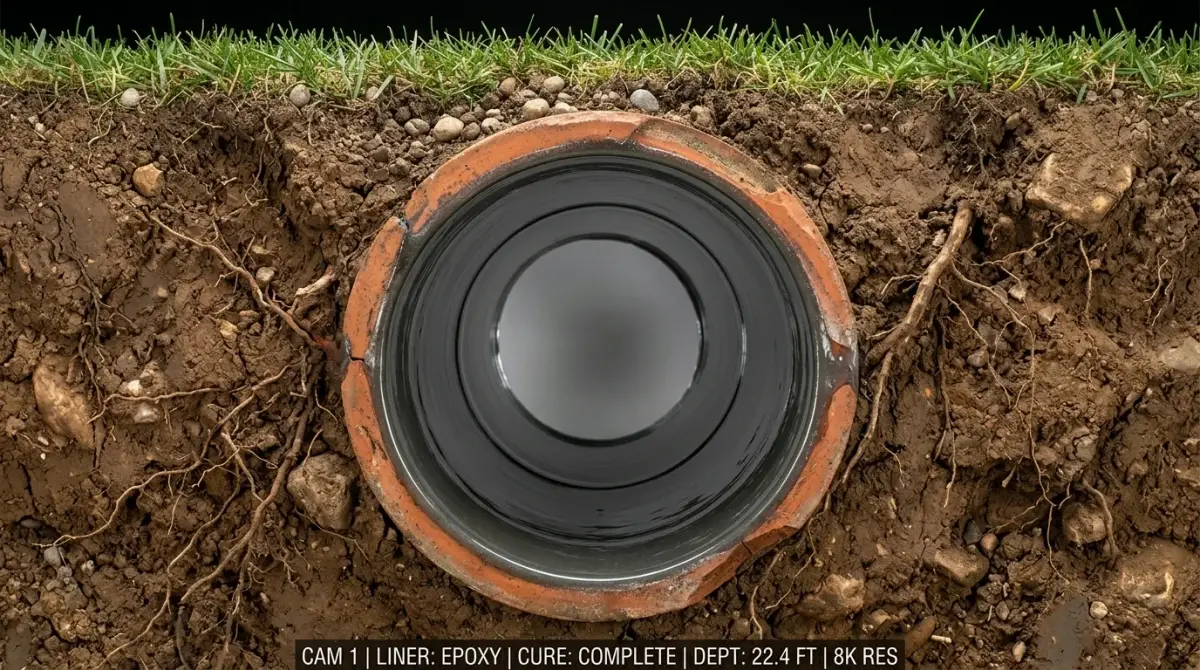
What is Cured-In-Place Pipe (CIPP) Lining?
CIPP (Cured-In-Place Pipe) lining is a non-destructive trenchless pipe restoration process where an epoxy-resin saturated felt liner is pneumatically inverted inside a damaged host pipe and cured into a jointless, structural pipe inside the old one.
CIPP Pipe Lining
Pneumatic liner inversion and steam or UV curing meeting ASTM F1216 standards to create a seamless, root-proof composite pipe.
HD Video Camera Audit
Fiber-optic camera evaluation passed through mainline cleanouts to locate root intrusions, bellies, and fractures before rehabilitation.
Minimal Surface Impact
Executed via small access cleanouts, keeping lawns, driveways, sidewalks, and interior flooring largely intact.
Transparent Diagnostic Terms
Call (864) 894-8055 for upfront diagnostic pricing explained before work begins, and priority dispatch availability.
Symptoms & Failure Root Causes
Technical Overview & Execution Scope
Cured-In-Place Pipe (CIPP) lining is a non-destructive sewer relining and pipe rehabilitation service that delivers seamless pipe restoration inside your existing failing line. An epoxy-saturated felt tube is inserted into the host pipe via an existing cleanout using pneumatic inversion or pull-in-place methods, and cured using steam, ambient heat, or ultraviolet (UV) light to create a smooth, jointless structural wall. Homeowners in Greer can start with trenchless sewer repair in Greer, SC.
- 01
Invasive Carolina oak and pine tree roots enter vitrified clay pipe joints, creating severe flow bottlenecks.
- 02
Cast iron sewer laterals develop internal tuberculation scale, snagging toilet paper and causing repetitive stoppages.
- 03
Micro-fractures along clay tile pipes allow sewage leakage, saturating surrounding foundation soil in Greer homes.
- 04
Cracked sewer laterals beneath concrete slabs leak wastewater without visible surface lawn symptoms.
- 05
Longitudinal stress cracks form along 1960s PVC sewer pipes due to soil expansion in Greenville County.
Field Execution & Diagnostic Visuals: Cured-In-Place Pipe (CIPP) Lining
Verifiable visual proof of non-destructive equipment execution, structural pipe liners, and HD video diagnostics.
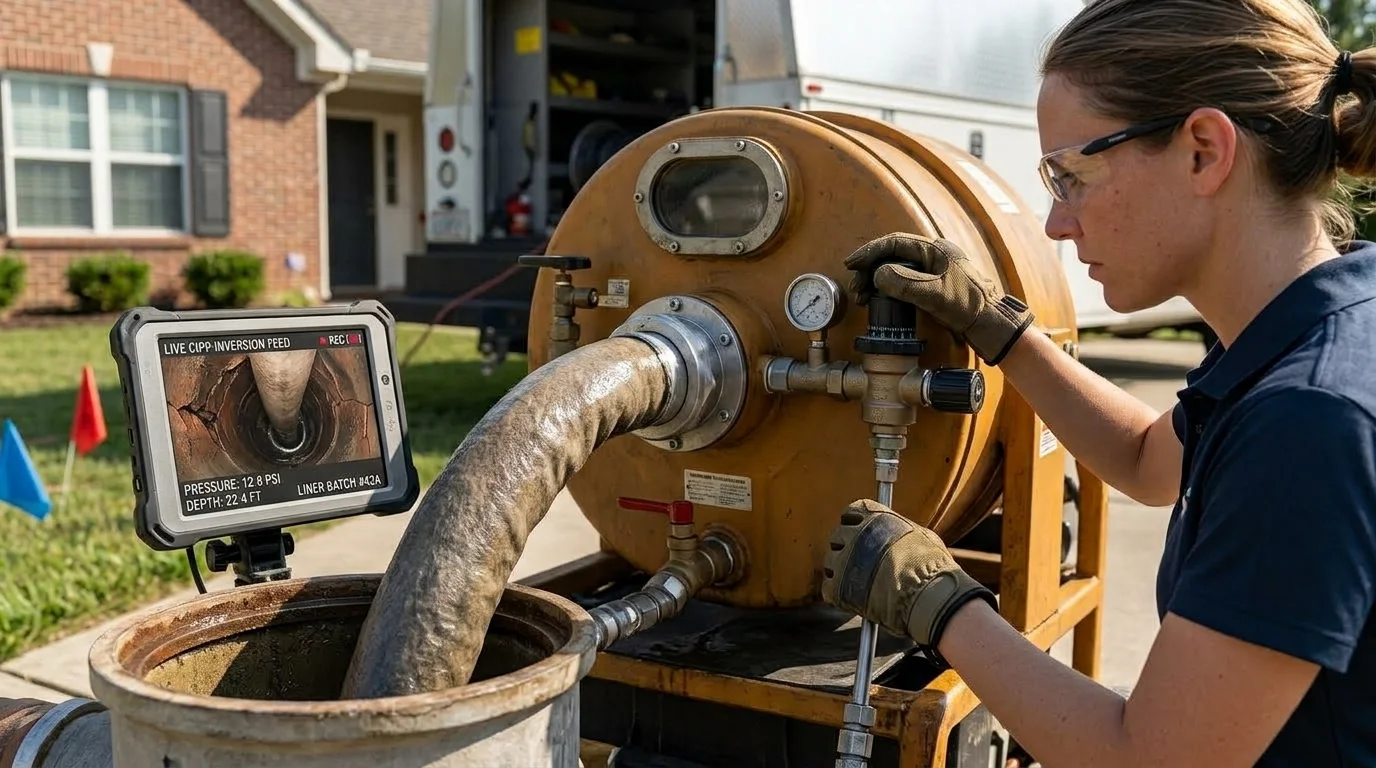
Resin-Saturated Liner Inversion
Technician operating a pressurized inversion drum, launching an epoxy-saturated resin tube into the subterranean host pipe.
✓ Verified Diagnostic & Execution Standard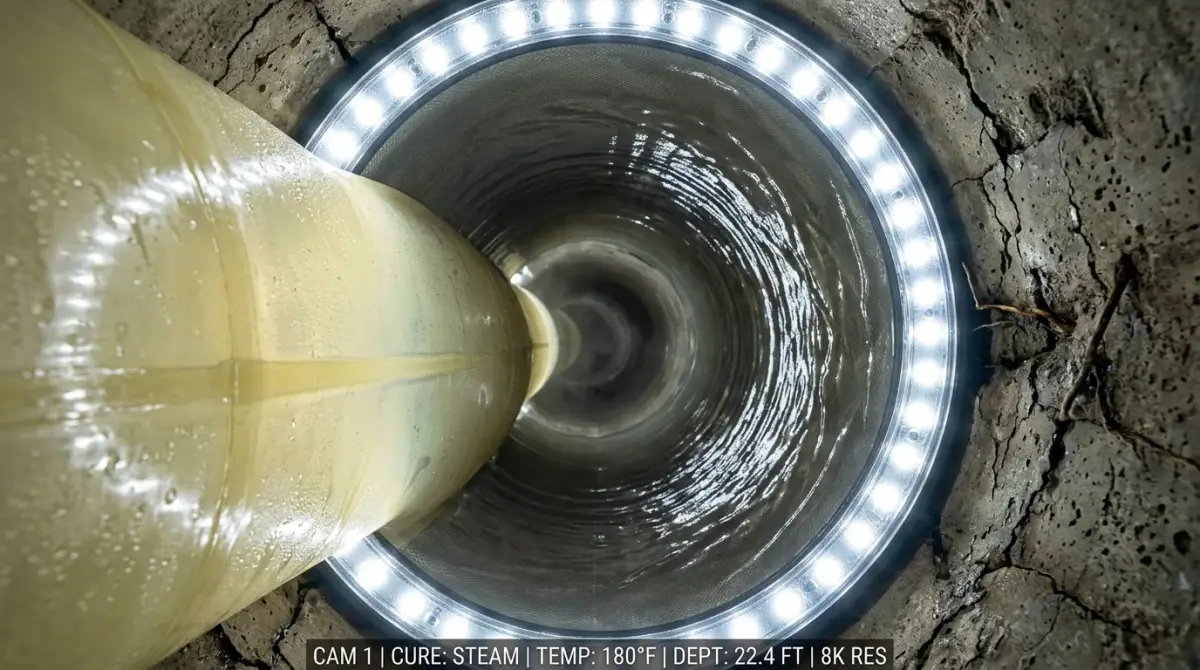
Calibration Bladder Inflation & Curing
Internal camera verification of CIPP epoxy liner inflated tight against host pipe walls during steam heat curing.
✓ Verified Diagnostic & Execution Standard Finished Jointless Structural Pipe
Cross-section of a subterranean sewer lateral showing a smooth, glossy, jointless structural resin liner sealing all old clay pipe fractures.
✓ Verified Diagnostic & Execution Standard4-Stage Technical Process: Cured-In-Place Pipe (CIPP) Lining
Trenchless sewer repair and pipe lining installations are executed through a standardized 4-stage process—combining HD camera diagnostics, hydro-jetting cleanout, CIPP felt inversion, and thermal curing—without a full-length trench through lawns or driveways.
Fiber-Optic Diagnostic Mapping
Camera inspection measures exact line diameter, length, and branch lateral locations.
Hydro-Jetting Scale & Root Removal
High-pressure water jetting strips internal rust scale, grease, and root masses down to bare pipe walls.
Liner Saturation & Pneumatic Inversion
Custom felt liner saturated with two-part epoxy resin inverted pneumatically or pulled into place inside host pipe.
Thermal Steam or UV Light Curing
Liner cured with ambient heat, steam, or UV light train, followed by robotic micro-cutter reopening of branch lines.
Key Cost Drivers: Cured-In-Place Pipe (CIPP) Lining
Trenchless sewer repair pricing is set by the contractor after diagnosis. Factors include host pipe burial depth, diameter, linear footage, and municipal right-of-way shoring requirements—communicated with upfront diagnostic terms.
Cost Per Linear Foot
High ImpactTotal length of continuous epoxy resin liner required from cleanout to city tie-in is a major cost factor.
Host Pipe Diameter
Medium ImpactStandard 4-inch residential line vs 6-inch commercial main scaling resin volume.
Branch Lateral Count
Medium ImpactNumber of active secondary branch lines requiring robotic cutter reinstatement.
Cleanout Access Availability
Low ImpactPresence of accessible ground-level cleanouts vs installing new entry access point.
Traditional Dig vs. Modern Method (Cured-In-Place Pipe (CIPP) Lining)
Compared to open-trench digging, which disturbs landscaping and can take several days, CIPP lining repairs the line through existing cleanouts. That can reduce the yard and driveway restoration a repair needs.
Where We Provide Cured-In-Place Pipe (CIPP) Lining Across Upstate SC
Independent trade specialists provide cured-in-place pipe (cipp) lining across our primary service hub and surrounding Upstate South Carolina municipalities:
Explore Related Services
Discover our full spectrum of non-invasive subterranean pipe restoration, high-pressure cleaning, and optical diagnostic capabilities across Greer and Upstate SC.
Cured-In-Place Pipe (CIPP) Lining Technical FAQ
Everything property owners ask before booking a trade service — answered honestly.
CIPP (Cured-In-Place Pipe) and pipe relining refer to the exact same trenchless technology. CIPP is the engineering terminology for structural pipe relining, where an epoxy-saturated felt sleeve cures inside an existing subterranean host pipe to form a seamless structural pipe.
CIPP lining is engineered for vitrified clay tile, cast iron, PVC, and corrugated metal subterranean sewer lines that retain circular structural integrity.
Thermal steam curing heats the epoxy with steam or hot water. UV light curing passes an ultraviolet light train through the liner to cure photopolymer resin. The crew chooses the method that fits the line.
Pull-in-place lining is deployed when a sewer lateral lacks a downstream exit pit or has multiple sharp bends, allowing technicians to pull the resin tube into exact position through a single access cleanout.
The liner takes up a small amount of the pipe diameter. Its smooth interior helps flow, and the camera check confirms the result.
CIPP liners are made to ASTM F1216, a standard for structural liners. Ask for the manufacturer design life data for your job.
No. CIPP creates a seamless, jointless continuous pipe from home stack to city main, eliminating the open joints where tree roots enter.
After curing, the liner is checked with a camera inspection to confirm it sits tight against the pipe wall, with no wrinkles or gaps. CIPP liner testing is covered by ASTM F1216. Ask for the manufacturer test records for your job.
Contact Trenchless Greer
Serving property owners across Greer, SC and surrounding Upstate South Carolina communities.
307 John St #3b, Greer, SC 29651, USA
Mon–Fri 8AM–6PM | Sat 9AM–2PM
Greer, South Carolina (35-Mile Radius)